- 0800 1337 444
- info@japaneseknotweedexpert.co.uk
- United Kingdom

If you’re buying, selling, or managing land in Shropshire, Japanese knotweed, as an invasive plant species, may not seem urgent at first—but it can quickly become a priority once a transaction is underway.


Most people don’t actively look for Japanese knotweed. It usually comes to light during due diligence—when a survey flags a concern, a buyer seeks reassurance, or a lender requests confirmation before moving forward. At that stage, managing uncertainty can be more important than managing the plant itself.
Properties across Shropshire range from privately owned gardens to long-established rural homes. In each case, Japanese knotweed is treated as a formal due-diligence matter, identified and addressed through professional assessment rather than assumed to be present.
What often determines the outcome is how quickly any concerns are clarified and clearly documented.
In Shropshire, Japanese knotweed questions usually arise during standard conveyancing or due-diligence checks, rather than because a property is assumed to be affected.
Common trigger points include:
Delays typically arise not because a serious issue exists, but because clear information has not yet been established.
Addressing Japanese knotweed questions early allows them to be managed efficiently without disrupting plans. If clarification comes later—after offers are agreed or deadlines are tight—uncertainty can create avoidable stress or lead to renegotiation. A Japanese knotweed infestation can impact property value, so the sooner clarification of knotweed occurs, the less financial effects will take place.
For buyers and property owners in Shropshire, the main risk is often uncertainty at the point when others in the transaction need reassurance.
Across all scenarios, the pattern is consistent: clear evidence early preserves options later.
| Situation | Why clarity is needed |
|---|---|
| Selling a property | Buyers or their advisers may require confirmation before committing. |
| Buying a property | Identifying any knotweed concerns early helps avoid complications after commitment |
| Land or development sites | Knotweed is treated as a documented consideration, assessed alongside other land or property factors |
Japanese knotweed does not automatically prevent property transactions in Shropshire when it is properly assessed and managed.
Unanswered questions can trigger extra scrutiny from lenders, surveyors, or legal advisers—often at the least convenient stage of the process.
We provide professional Japanese knotweed surveys, treatment and removal services throughout Shropshire, including Shrewsbury, Ludlow, Bridgnorth, Market Drayton, Newport, Shifnal, Craven Arms, Wem, Clun, Ellesmere and surrounding areas.
If Japanese knotweed has been mentioned—or you suspect it may be present—the best next step is to seek site-specific advice rather than rely on assumptions.
We establish whether a formal Japanese knotweed assessment is actually needed, based on your specific situation rather than assumptions.
We advise on what type of reporting would be appropriate, proportionate and acceptable to lenders, solicitors or planners.
By dealing with likely questions at the right stage, we help prevent delays, disputes or last-minute requests later in the process.
Handled early, knotweed becomes a managed factor, not a lingering constraint.
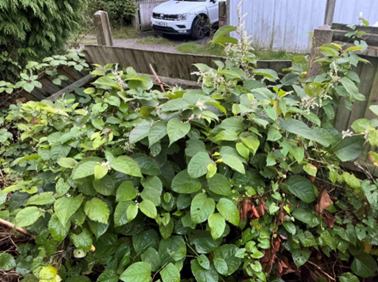
A private, rural residential property in Shropshire with a Japanese knotweed stand measuring approximately 12 m² within the garden; visible growth was also noted on neighbouring land.
The proximity of off-site growth created a risk of underground rhizome spread beyond the property boundary, requiring a coordinated approach to prevent reinfestation.
A professional assessment confirmed the on-site stand as the primary source. A treatment programme combining targeted spraying and stem injection with a glyphosate-based herbicide was recommended as the most effective long-term control strategy.
The documented management approach provided a clear position for the property and surrounding land, supporting early clarity in the transaction, with indicative costs of £2,984.40 + VAT.
Yes. We offer Japanese Knotweed excavation across Shropshire, including Shrewsbury, Telford, Ludlow, Oswestry, and Bridgnorth. Both residential and commercial properties are supported, with full waste-handling compliance.
Japanese Knotweed thrives along the River Severn, canal networks, old industrial sites, and redeveloped farmland. Properties on town outskirts and near historic land disturbances are particularly affected.
Excavation is recommended when:
Property sales or mortgages need speed
Construction or landscaping is planned
Knotweed is dense or near structures
It provides a faster, permanent solution compared to long-term herbicide application.
Excavated material is classified as controlled waste under the Environmental Protection Act. Licensed carriers transport it to approved facilities that accept invasive plant waste, fully compliant with local regulations.
We carry out a detailed site-specific risk assessment, particularly for terraced housing, shared boundaries, and public land. Excavation is carefully managed to prevent spread or disturbance.
Yes. Excavation projects can include a long-term guarantee, with insurance-backed options available. This is often requested by lenders, solicitors, and surveyors during property transactions.